Visiting Temples in Sri Lanka
What to wear, when to go, and what to never do inside.
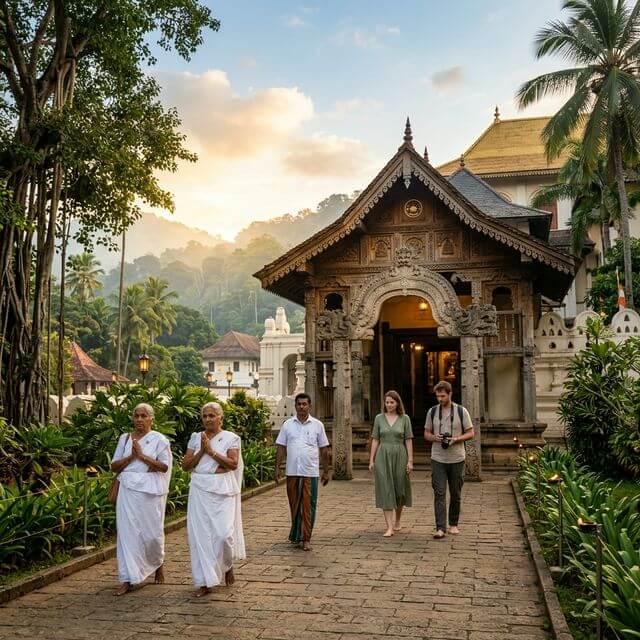
Turned away at the entrance is not a great start to the day
It happens more than you think. A tourist arrives at the Temple of the Tooth in Kandy (see Kandy guide), queue of people, ticket bought, shoes off at the door. Then a guard points at the shorts and shakes his head.
The rules at Sri Lanka's religious sites are not complicated. They are just not the kind of thing airlines or hotel booking confirmations tell you about. This page fixes that in three minutes.
The rule is basically the same everywhere
Shoulders covered. Knees covered. Shoes off at the entrance. Hat off when you walk in.
That applies to Buddhist temples, Hindu kovils, mosques, and churches. The religion changes. The basics do not.
For men: long trousers and a t-shirt with sleeves. No vests, no sleeveless tops. Shorts will get you turned away at most major temples. No exceptions.
For women: anything that covers knees and shoulders. A light scarf over a sleeveless top works fine. Long skirts, loose trousers, linen dresses. The more modest the better at major sites like Kandy and Dambulla.
Local Tip
One thing worth carrying: a thin sarong or light scarf takes up almost no space in a bag and solves the problem instantly if you are wearing shorts or a sleeveless top. Most major temples lend or hire sarongs at the entrance but having your own is less hassle.
The stricter ones to know about
Temple of the Tooth, Kandy
This is the most visited religious site in Sri Lanka and they do not bend the rules here. It is always wise to double-check opening hours on the official Maligawa website. Shoulders covered, knees covered, shoes off, hats off. No tight clothing either. Sarongs are available at the entrance if you need one.
Golden Temple, Dambulla
Same rules as Kandy, strictly enforced. If you are reading our Sigiriya guide, you will likely pass this temple. The climb up to the cave entrance is in full sun and can be hot, so light long trousers in a breathable fabric make more sense than jeans.
Hindu kovils
Same dress code as Buddhist temples in general. The difference is that some inner shrines at Hindu kovils are restricted to Hindu worshippers only. Look for signs or ask before walking into inner chambers. At some kovils men must remove their shirt to enter certain areas.
Mosques
Shoulders and knees covered for both men and women. Women are also expected to cover their hair inside. A scarf or shawl works fine. Remove shoes at the entrance. Mosques are active places of worship, so keep voices low and do not walk through if prayers are happening.
Churches
Generally more relaxed than Buddhist temples or kovils. Modest clothing is appreciated but the rules are not enforced at the door the same way. Shoulders covered is still respectful. Sri Lanka's colonial-era churches are often genuinely beautiful and worth visiting for the architecture alone. There are several fine examples inside Galle Fort.
Small roadside temples
The small local temples you pass throughout the country are places where local families worship daily. If you want to look inside, do so quietly and respectfully from the entrance. Remove shoes if you step inside. Ask before photographing anything. These are not tourist sites.
Photography: always check first
Most temples allow photographs of the grounds and exterior. Inner chambers, shrines, and statues are a different matter.
Look for signs near the entrance or the inner shrine. If there is no sign and you are not sure, ask a guard or monk. Nobody minds the question. People do mind a tourist with a camera where cameras are not welcome.
Never photograph people who are praying or meditating. Do not pose for photos with your back to a Buddha statue. This is considered disrespectful and will cause genuine offence to worshippers nearby.
One more thing: tattoos of the Buddha or any deity should be kept covered throughout Sri Lanka. This is not a small issue. People have been refused entry and in some cases deported for it.
Go on a weekday. Seriously.
Buddhist temples in Sri Lanka are busy on two types of days: weekends and Poya days.
Poya is the full moon day each month, which is a public holiday in Sri Lanka. Every Buddhist temple in the country gets very busy. Local families come in white clothing to make offerings, light incense, and pray. It is genuinely worth seeing once for the atmosphere. But if you are there purely to sightsee, Poya days make it harder.
Any weekday morning is the opposite. The Temple of the Tooth at 7am on a Tuesday feels completely different from the same place at 11am on a Saturday. Fewer people, calmer atmosphere, and better light.
Worth knowing
The three daily puja ceremonies at the Temple of the Tooth are at 6:30am, 9:30am, and 6:30pm. The early morning one is the most genuine. Get there 20 minutes before it starts.
A few other things that matter
Read the sign boards
Every major religious site in Sri Lanka has sign boards at the entrance listing the rules. Take 30 seconds to read them. Rules vary between sites and the sign tells you exactly what applies here.
Keep your voice down
Temples are active places of worship, not museums. People are praying, meditating, and performing rituals. Talking loudly or playing music is genuinely disruptive.
Do not touch the statues
Buddha statues and deity figures are considered sacred. Touching them, leaning on them, or posing in contact with them is disrespectful.
Wear socks if you can
You will remove your shoes at every temple entrance. In the middle of the day the ground outside can get extremely hot. Socks are perfectly acceptable inside Sri Lankan temples.
Carry small change
Many temples have donation boxes. At smaller sites a monk or priest may show you around personally. In both cases, a small cash contribution is appropriate and appreciated.
The rules are the owner's choice
These dress code rules are set by the people who manage each site. Different temples have different rules. The best approach is to be prepared for the strictest version.
Quick Answers
Not at major temples like the Temple of the Tooth in Kandy or the Golden Temple in Dambulla. You will be turned away at the entrance. Wear long trousers or carry a sarong and you will never have a problem anywhere.
Most major temples have sarongs available at the entrance, either free or for a small fee. They wrap around your waist or shoulders and solve the problem quickly. Having your own thin sarong in your bag is a much smoother solution.
Poya is the full moon day each month, a public holiday in Sri Lanka. Buddhist temples are packed with worshippers. The atmosphere is genuinely special. But if you want a quieter visit for sightseeing, any weekday morning is significantly calmer.
It depends entirely on the specific temple and the specific area within it. Check sign boards at the entrance. Grounds and exterior are almost always fine. Inner shrines are frequently restricted. When in doubt, ask a guard or monk.
The core principle is the same across Buddhist temples, Hindu kovils, mosques, and churches: modest dress, shoes off, respectful behaviour. Sign boards at each site tell you what specific details apply there.