Money, ATMs and Tipping in Sri Lanka
What works, what does not, and what nobody mentions until you are stuck.
The simple rule: outside Colombo, carry cash
In Colombo you can pay by card at most hotels, restaurants, and shops. Supermarket chains like Cargills and Keells accept cards everywhere and do not add fees. Most fuel stations around the country take cards too.
Everywhere else? Cash. Tuk-tuks, local restaurants, markets, guesthouses in smaller towns, street food, temples. Even places that technically have a card machine sometimes prefer cash and will quietly ask you to use it. Do not be surprised. It is just how it works outside the city.
Small village shops in rural areas have never seen a card machine. Cash only, always, no exceptions.
Local Tip
Withdraw enough cash when you are in a city or large town. Do not leave it until you are in Ella or a small coastal village and suddenly need to pay for something. There may not be a working ATM nearby.
The 3% card fee you might not notice
Some businesses in Sri Lanka add a 3% surcharge when you pay by card. Not all of them mention it upfront.
You might notice it only when the total on the machine is slightly more than the price on the menu. Or you might not notice at all.
At smaller guesthouses, tour operators, and independent restaurants this is fairly common. At major supermarkets and chain hotels it does not happen.
The fix is simple: if you are paying a larger bill, ask before handing over the card. "Is there a card fee?" takes two seconds and saves you a surprise. If there is a fee and you have cash, use the cash.
ATMs: the ones that work and the ones to avoid
Sri Lanka has nearly 4,000 ATMs. Most of them work fine with foreign Visa and Mastercard. But not all of them.
There are two broad categories: government banks and private banks. This matters more than you would expect.
Government bank ATMs: approach with caution
Peoples Bank, Bank of Ceylon (BOC), and NSB are the main government banks. Peoples Bank ATMs are notoriously unreliable with foreign cards. Many visitors have stood at a Peoples Bank ATM, card in hand, and got nothing. BOC generally works better. NSB is hit and miss.
If a government bank ATM is your only option, try BOC first. If that fails too, find a private bank ATM before giving up.
Private bank ATMs: use these
HNB, Commercial Bank, Sampath Bank, NTB, NDB, and Seylan all work reliably with foreign Visa and Mastercard. These are the ATMs locals and experienced travellers head to directly. When you see one, use it. Do not walk past looking for something else.
| Bank | Type | Foreign card reliability |
|---|---|---|
| HNB | Private | Excellent |
| Commercial Bank | Private | Excellent |
| Sampath Bank | Private | Very good |
| NTB / NDB / Seylan | Private | Very good |
| Bank of Ceylon (BOC) | Government | Generally fine |
| Peoples Bank | Government | Unreliable with foreign cards |
| NSB | Government | Mixed results |
ATM fees
Most ATMs charge a fee of roughly 0.60 to 1 EUR per transaction for foreign cards. Your home bank will likely add its own fee on top of that. To reduce this, withdraw larger amounts less frequently rather than small amounts multiple times a day.
Withdrawal limits range from roughly 70 to 550 EUR depending on the bank. Most machines sit between 110 and 165 EUR per transaction.
Always choose LKR. Never accept the conversion.
This one catches a lot of people and costs real money.
When you use an ATM or pay by card in Sri Lanka, the machine may ask: "Do you want to pay in Sri Lankan Rupees or British Pounds / Euros?"
Always choose Sri Lankan Rupees. Always decline the conversion.
If you accept, the ATM converts at its own exchange rate and charges an extra percentage fee for doing so. If you decline, your own card provider converts at the Visa or Mastercard rate, which is almost always better. The ATM conversion is almost always worse. Sometimes significantly worse.
The screen words vary: "Accept or Decline Conversion", "With or Without Conversion", "Charge in LKR". Whatever it says, choose LKR, decline, or without. Same principle, same result.
The best cards to bring from Europe
Your regular debit or credit card works fine in Sri Lanka. But if you want to reduce fees, two options are worth knowing about.
Wise and Revolut both offer multi-currency accounts with much lower foreign transaction fees than traditional European banks. Revolut does not charge additional fees on ATM withdrawals within plan limits, and converts at competitive exchange rates without hidden markups. Wise works similarly and is widely used by long-term travellers.
If you travel regularly, either of these is worth setting up before your trip. If you only travel occasionally, your existing card works fine. Just withdraw larger amounts less often to keep ATM fees manageable.
Practical Tip
Bring two cards from two different networks if you can, ideally one Visa and one Mastercard. Some ATMs in Sri Lanka only accept one or the other. Having both means you are never stuck.
Sri Lankan Rupees: the notes you will use
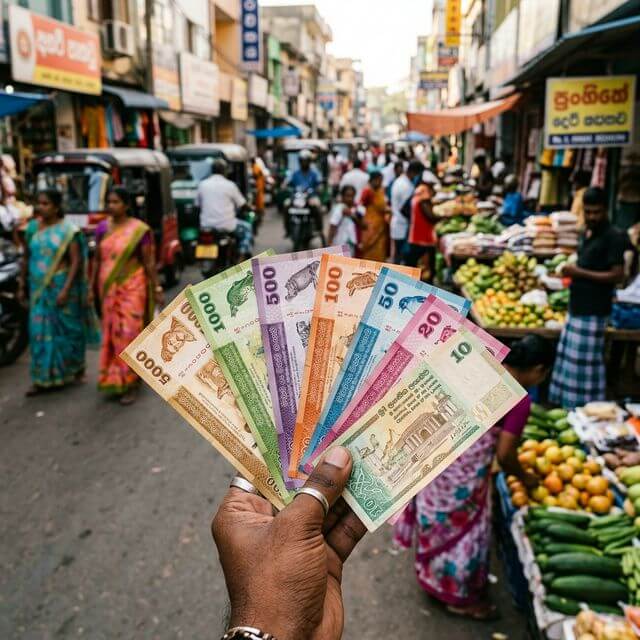
The Sri Lankan Rupee (LKR) comes in notes of 20, 50, 100, 500, 1000, 2000 and 5000. The 5000 note is the largest. Most daily transactions happen in 100s and 500s.
Keep small notes handy for tuk-tuks, street food, and temples. Handing a large 5000 note to a tuk-tuk driver for a short trip is awkward for everyone. ATMs usually dispense 1000 and 2000 notes. Break them down at supermarkets and larger restaurants when you can.
Do not try to change money at the airport unless you need a small amount for the taxi. The rates inside the arrivals hall are noticeably worse than ATM rates or licensed money changers in Kandy or Galle.
Tipping: nobody is expecting it
Sri Lanka is not the USA. There is no tipping culture where you feel socially obligated to add 20% to every bill. Sri Lankans do not expect tips and will not be offended if you do not give one.
That said, if someone has genuinely helped you, tipping is a lovely thing to do. A driver who waited for you, a guide who went out of their way, a guesthouse owner who sorted out a problem at midnight. These people earn modest incomes and a small tip means more here than the same amount means in Europe.
What to give if you want to tip
There are no rules. Use your judgment based on the service and the context. As a rough guide that fits how locals think about it:
Tuk-tuk driver
Round up or add roughly 0.50 EUR on top of the fare for good service. Not expected. Always appreciated on longer trips or if they helped with bags or waiting.
Restaurant
No standard percentage applies. Leaving the loose change on the table is fine. At nicer restaurants, 1 to 2 EUR is generous. Check the bill first as some tourist restaurants already include a service charge.
Tour guide or day driver
For a full day tour or a long transfer with a helpful driver, 2 to 3 EUR is appropriate and meaningful. For an exceptional guide who significantly enhanced your experience, more is entirely reasonable.
Hotel and guesthouse staff
Not expected at budget guesthouses. At mid-range and above, roughly 1 to 2 EUR left at checkout for housekeeping is a nice gesture. Tips at resort-level properties can be higher.
Porters and helpers
Anyone who carries your bags, helps with directions, or assists in a practical way: 0.50 EUR per bag or per meaningful help. Simple and fair.
Temple guides and monks
At small temples a cash donation to the donation box is more appropriate than a personal tip. If a monk or guide has specifically shown you around, roughly 0.50 EUR in the donation box is the right way to give.
Golden Rule
Tip in cash, always. Handing a note directly to the person is far more meaningful than adding it to a card payment. Many tip amounts on card payments do not actually reach the person who served you.
Quick answers
Sri Lankan Rupees are hard to find outside Sri Lanka and the rate if you do find them is usually poor. Bring your regular card and withdraw from an ATM on arrival. Get a small amount at the airport ATM for your first taxi and a bite to eat, then use private bank ATMs in Colombo city for everything else. The city ATM rates are better than the airport.
Enough for 2 to 3 days of spending when you are outside a city. Once you leave Colombo, Kandy, or Galle, assume you might not find a working ATM for a while. In smaller towns like Ella, ATMs exist but can be limited. In rural areas between stops, there may be nothing. Withdrawing generously in a city before heading into the countryside is the practical approach.
Most likely one of three things. First, you used a Peoples Bank ATM, which are unreliable with foreign cards. Try an HNB or Commercial Bank ATM. Second, your home bank blocked the transaction as suspicious activity abroad. Call or message your bank before you travel to tell them you are in Sri Lanka. Third, the specific ATM was out of cash or temporarily offline. Try a different machine at a different bank.
Generally yes. Use ATMs attached to bank branches during daylight hours where possible, rather than standalone machines in quieter locations. Card skimming does occur occasionally in Sri Lanka as in any tourist destination. Check the card slot for anything that looks loose or unusual before inserting your card. Cover the keypad when entering your PIN. Using contactless where available avoids the skimmer risk entirely.
No. Tipping is not a social expectation in Sri Lanka the way it is in the USA. Nobody will be offended, comment on it, or give you a look if you do not tip. It is entirely optional. If someone has genuinely helped you and you want to show appreciation, a small tip is a kind gesture. If the service was ordinary, there is no obligation at all.